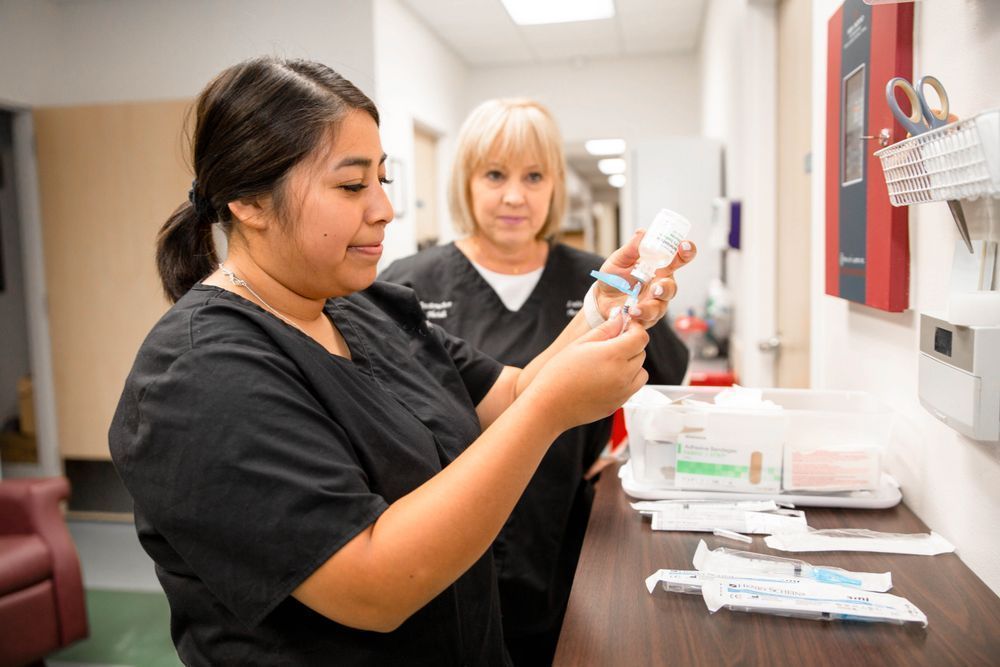
CNA school online is trending — and it makes sense. CNA training is short, relatively inexpensive, and gets you into healthcare quickly. But before committing to a CNA program, it’s worth understanding how the career compares to medical assisting on the metrics that matter most: salary, job growth, scope of work, and long-term career options.
The two paths start in a similar place but lead to very different destinations.

The Direct Comparison
| Factor | CNA | Medical Assistant |
|---|---|---|
| Training time | 4–12 weeks | 16–18 weeks (accelerated) |
| Median salary | $36,000/year | $42,000/year |
| Job growth | 4% through 2032 | 14% through 2032 |
| Work setting | Nursing homes, hospitals | Clinics, physician offices |
| Schedule | 12-hr shifts, nights, weekends | Standard business hours typical |
| Scope | Basic patient care | Clinical + administrative |
| Physical demand | Very high | Moderate |
| Certification | State CNA exam (required) | CCMA (recommended) |
| Career paths | LPN → RN nursing track | Clinical, admin, or nursing |
The Salary Gap Is Real
Medical assistants earn approximately $6,000 more per year at the median — and the gap widens with experience and certification:
| Experience | CNA Salary | MA Salary | Annual Difference |
|---|---|---|---|
| Entry-level | $28,000–$32,000 | $33,000–$38,000 | +$5,000–$6,000 |
| Mid-career | $32,000–$38,000 | $38,000–$45,000 | +$6,000–$7,000 |
| Experienced | $38,000–$42,000 | $45,000–$55,000 | +$7,000–$13,000 |
Over a 10-year career, the medical assistant salary advantage adds up to roughly $60,000–$100,000 in additional cumulative earnings.
The Job Growth Gap Is Even Bigger
Medical assistant employment is projected to grow 14% through 2032 — nearly four times the 4% growth rate for CNAs. That means:
- More job openings for medical assistants
- More competition among employers for trained MAs (which drives up wages)
- More geographic options and practice type choices
- Greater job security long-term
The growth difference reflects a structural shift in healthcare: more care is moving to outpatient settings (where MAs work) and away from institutional settings (where CNAs work).
The Work Itself Is Different

CNA daily work
- Assisting patients with bathing, dressing, eating, and mobility
- Monitoring and recording vital signs
- Repositioning bedridden patients
- Changing linens and maintaining patient comfort
- 12-hour shifts, often including nights, weekends, and holidays
- Physically demanding — lifting, standing, constant movement
- Emotionally intense — working with very sick or declining patients
Medical assistant daily work
- Taking vitals and rooming patients
- Drawing blood, giving injections, running EKGs
- Assisting providers during exams and procedures
- Managing schedules, insurance verification, and EHR documentation
- Processing prior authorizations and prescription refills
- Standard business hours more common
- Mix of clinical and desk work throughout the day
Both roles are meaningful and essential. The question is which type of work, schedule, and environment matches your life and goals.
The Online Training Question
CNA school online faces the same challenge as any clinical training: patient care skills require hands-on practice. Most CNA programs are primarily in-person because the work involves physical patient handling. “Online CNA school” often means the didactic portion is virtual, with required in-person clinical hours at a care facility.
Medical assistant training online follows a similar hybrid model in the best programs: online for knowledge-based content (terminology, anatomy, admin procedures) and in-person for clinical skills (phlebotomy, injections, EKGs). The hybrid approach works well for medical assisting because the administrative component is inherently computer-based.
When CNA Makes Sense
CNA training is the right choice if:
- You specifically want to pursue nursing (LPN → RN) and want healthcare exposure first
- You need the absolute fastest entry into healthcare (some CNA programs are 4 weeks)
- You’re drawn to direct, personal patient care in hospital or long-term care settings
- Budget is the primary constraint (CNA training costs $500–$1,500)
When Medical Assistant Training Makes Sense
Medical assistant training is the stronger choice if:
- You want higher pay from the start and throughout your career
- You prefer standard business hours over 12-hour shifts
- You want a broader skill set (clinical + administrative)
- You value career flexibility — clinical, administrative, or nursing advancement paths
- You want to work in outpatient settings (clinics, offices, urgent care)
- You can invest 16–18 weeks and $2,000–$5,000 for significantly better long-term outcomes
The Bottom Line
CNA school gets you into healthcare slightly faster at a lower cost. Medical assistant training takes a few extra weeks but leads to higher pay, faster job growth, more career flexibility, and a more sustainable work-life balance. For most people weighing these two options, the additional investment in medical assistant training produces significantly better long-term returns.
Explore Medical Assistant Training
Zollege offers medical assistant programs at over 200 locations nationwide — 16–18 weeks of hands-on training with CCMA certification preparation and no student loan debt. Find a program near you.